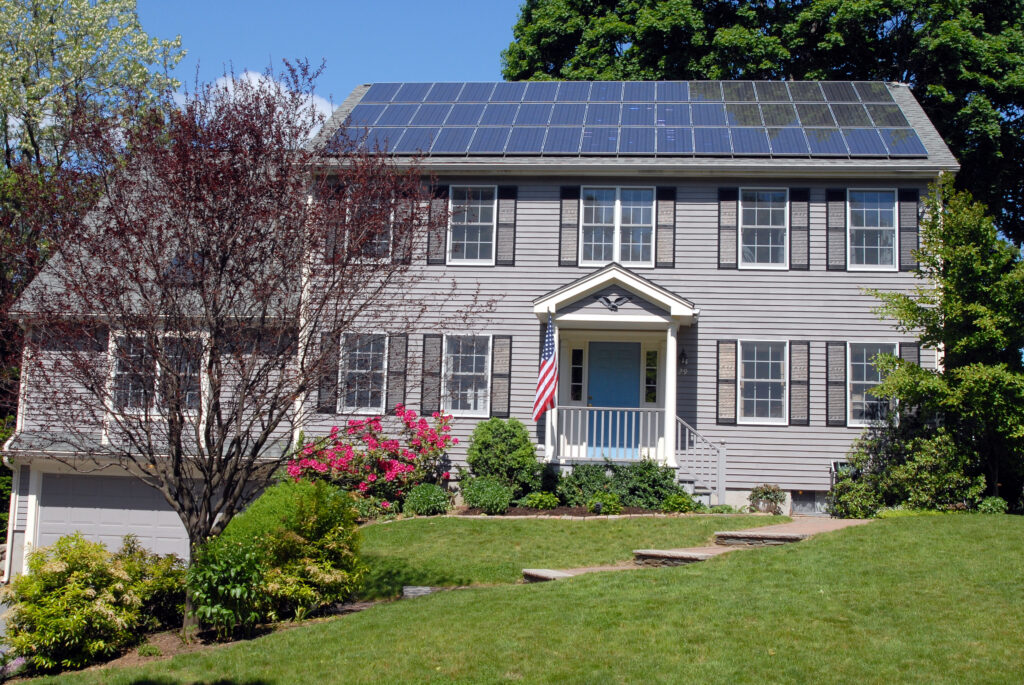
Quick answer: Assess the whole project—not just its electricity production. Before installing solar or small wind, ask what equipment manufacturing involves, what the installation will disturb, whether wildlife needs specialist assessment, how maintenance will be handled, and who will remove and manage retired equipment. Solar generation has no operating air emissions, but manufacturing and disposal still have environmental impacts. Wind siting also requires attention to wildlife and habitat. (eia.gov)
This guide is for homeowners, rural property owners, farmers, and small businesses considering rooftop solar, ground-mounted photovoltaic panels, or a tower-mounted small wind turbine. Regulatory and recycling examples are U.S.-specific; elsewhere, use the equivalent environmental agency and local planning authority.
Start a project folder with five items: an equipment list, an energy-production estimate, a site drawing, a maintenance plan, and an end-of-life plan. Use the questions below to identify what is documented and what remains unknown.
1. What does the manufacturing claim actually cover?
Solar panels require materials such as glass and metal, whose production uses energy. Manufacturing photovoltaic cells also involves hazardous chemicals that require controlled handling. “No emissions while generating electricity” therefore does not mean “no environmental impact.” (eia.gov)
Ask the supplier:
- Is there a published environmental assessment for the proposed equipment?
- Does it cover only the panel or turbine, or the complete installation?
- Are mounting structures, foundations, electrical equipment, transport, replacements, and disposal included?
- Which manufacturing locations and electricity supplies does it assume?
- Is it specific to this product, or an average for a technology category?
A life-cycle assessment examines impacts across stages of a system’s life. A 2024 national-laboratory study of utility-scale solar, for example, evaluated manufacturing supply chains, installation locations, and alternative end-of-life treatments. Those assumptions matter; its results are not automatically a footprint estimate for a particular residential roof. (research-hub.nlr.gov)
Practical check: Ask anyone making a “lower-carbon” claim to identify the comparison and provide the underlying study. Treat a claim without a defined scope as unverified—not necessarily false, but insufficient for choosing between proposals.
2. Can the project use an existing roof or already-disturbed space?
Compare locations before choosing equipment. A roof, a maintained yard, a working field, and an intact habitat are not equivalent starting points.
As a planning approach, investigate suitable existing structures and already-disturbed areas before proposing new clearing. EIA identifies habitat disturbance from land clearing as an environmental concern for solar development. That does not establish a universal ranking for every small property; it gives you a reason to examine what each location would replace. (eia.gov)
For rooftop solar, request a layout and ask:
- Can the proposed array work without removing trees?
- Should roof repairs happen before installation?
- Where will cables and other equipment go?
- What removal and reinstallation work would a future roof replacement require?
For ground-mounted solar, mark more than the panel footprint. Include foundations, trenches, construction access, fencing if proposed, and the area needed for maintenance. Ask the installer to distinguish temporary disturbance from permanent changes.
For small wind, include the tower, foundation, any guy-wire anchors, cable route, and service access. DOE’s guidebook emphasizes the need for space around guyed towers and for raising or lowering equipment where applicable. (energy.gov)
Common mistake: Comparing only the visible equipment. Request a drawing that shows the complete construction and service area.

3. What habitat, soil, and water features need protection?
Before accepting a ground-mounted layout, walk the proposed construction area and cable route. Record features you want the installer—and, where necessary, a qualified environmental professional—to assess:
- Streams, ponds, wet areas, and drainage channels
- Native vegetation, hedgerows, mature trees, and wooded edges
- Suspected nesting or roosting locations
- Slopes, exposed soil, and places where heavy equipment would travel
- Existing agricultural uses that must continue
These observations are a screening exercise, not a wildlife survey or a legal determination.
For a ground-mounted solar proposal, request a construction plan addressing clearing, grading, runoff, soil protection, and revegetation. If the proposal advertises a “pollinator-friendly” planting, ask for the actual seed mix, establishment work, and long-term vegetation-management plan. Do not accept the label alone as evidence of a habitat benefit.
Keep the solar technology clear. This article concerns photovoltaic panels, not concentrating solar power towers. EIA’s warning about intense concentrated sunlight harming flying wildlife concerns solar power towers; it should not be presented as a characteristic of an ordinary household PV array. (eia.gov)
Practical check: Put agreed protection areas on the contractor’s site drawing. Ask who will verify them before excavation and who will restore temporarily disturbed ground.
4. Does the small-wind location need wildlife assessment?
A small turbine is not a utility-scale wind farm, but its size alone does not settle its wildlife risk.
The U.S. Fish and Wildlife Service identifies turbine placement, landscape use by birds, and turbine design as factors influencing collision risk. Early site planning is an important opportunity to avoid or reduce impacts. (fws.gov)
Ask your state wildlife agency or appropriate Fish and Wildlife Service field office whether the proposed location raises concerns involving birds, bats, sensitive habitat, or protected species. Provide the proposed tower location and design rather than asking about “wind power” in general.
The Service’s voluntary land-based wind guidelines use progressively more detailed assessment. They anticipate that many distributed or community facilities will not need to proceed beyond preliminary screening and site characterization. That is not an automatic exemption or a finding that a particular property is safe. (fws.gov)
Request written answers to three questions:
- What wildlife information was reviewed?
- Does the proposed location need a closer assessment?
- Would another location or design avoid a concern?
Do not move the turbine onto a roof simply to avoid ground disturbance. DOE warns that rooftop turbines can transmit vibration into buildings and encounter turbulence that reduces production and shortens equipment life. (energy.gov)
5. How will maintenance and replacement be handled?
Ask for a maintenance plan before purchasing, not after the equipment develops a problem.
For small wind, DOE advises obtaining the manufacturer’s operating and maintenance instructions. Depending on the design, servicing can involve lubrication, wear-part replacement, corrosion checks, and checks of connections and guy-wire tension. Requirements are equipment-specific. (energy.gov)
Ask:
- Who can service this model locally?
- What access or lifting equipment will servicing require?
- How will used fluids and replaced parts be collected?
- Are replacement parts available, and what happens if they are not?
- Who responds to storm damage or unusual operation?
For solar, request model-specific inspection and cleaning guidance. If cleaning is proposed, ask when it is needed, what products are permitted, and how water and runoff will be managed. For ground-mounted arrays, specify how vegetation will be controlled and whether mowing or chemical treatment is proposed.
If the project includes batteries, include them explicitly in the maintenance and retirement plans. EPA notes that panels, inverters, racking, and batteries may follow different recycling routes. (epa.gov)
Common mistake: Treating an equipment warranty as a complete ownership plan. Ask separately who performs the work, who pays for access and transport, and who manages removed components.
6. Where will retired equipment actually go?
“Recyclable” is not a collection arrangement. Ask for a documented route that accepts the equipment you intend to buy.
EPA describes solar-panel recycling processes that recover different combinations of materials. Its guidance also notes that comprehensive recovery is not yet occurring at large scale in the United States. Ask what a proposed recycler recovers rather than assuming every material returns to new panels. (epa.gov)
Request these details:
- The collection provider or receiving facility
- Whether it accepts your panel technology and damaged equipment
- Whether it accepts household quantities
- Packaging, pickup, and transport requirements
- Fees and who pays them
- Documentation showing what happened to the equipment
EPA advises household panel owners to contact state or local recycling agencies. It also cautions that some discarded panels are hazardous waste and others are not; the answer cannot safely be inferred from appearance alone. (epa.gov)
Regional example: Washington. As checked on October 6, 2026, Washington Ecology reports that the deadline requiring manufacturers to have an approved stewardship plan to sell panels in the state was delayed from July 1, 2025, to January 31, 2031. Do not assume the law’s existence means an operating takeback service is available for your panels today. (ecology.wa.gov)
Ecology directs households to EPA’s recycling guidance and provides separate guidance for business-generated waste. Ownership and use can affect the applicable route, so farms, businesses, and leased-system customers should identify who is responsible before removal. (ecology.wa.gov)
For wind, request separate destinations for the tower, electrical equipment, blades, and any batteries or fluids. Do not assume a scrap-metal outlet accepts the whole turbine.
7. Compare the options with a worked screening example
Consider an illustrative property, not a documented installation: it has an existing roof, a maintained open area, and a wooded boundary. The owner is considering all three technologies.
Use this checklist to decide what to investigate next:
| Practical question | Rooftop solar | Ground-mounted solar | Small wind |
|---|---|---|---|
| What site information is needed? | Roof condition, layout, shading, cable route | Clearing, grading, drainage, vegetation, access | Wind resource, tower layout, obstacles, service access |
| What environmental question needs attention? | Whether the design requires tree removal | What habitat and soil disturbance can be avoided | Whether wildlife screening flags the location |
| What ownership plan is needed? | Maintenance and future roof-work arrangements | Vegetation management and ground restoration | Scheduled service and component replacement |
| What retirement evidence is needed? | Panel and electrical-equipment collection route | Collection route plus removal and restoration scope | Component-specific destinations and tower removal plan |
Step one: Investigate the roof without assuming it is suitable. If it can accommodate the project without tree removal, retain it as a candidate.
Step two: Ask whether the maintained open area allows a ground array without extending construction into the wooded boundary. Request the full disturbance drawing.
Step three: Do not order the wind turbine until both its energy potential and wildlife questions have been assessed. DOE recommends site-specific annual energy estimates rather than relying on rated power alone. (energy.gov)
This example cannot identify an environmental winner: it lacks production estimates, equipment life-cycle evidence, and local ecological findings. Its useful result is a list of evidence to obtain.
Before signing, require clear answers on equipment scope, site disturbance, wildlife concerns, maintenance responsibility, and retirement destinations. An unknown should become an assigned follow-up task—not disappear behind a “green energy” label.