Quick answer: Your property is worth investigating for small wind if it has a usable wind resource at the proposed turbine height, room for an appropriate tower, and a workable permitting and electricity-connection path. A windy afternoon, large acreage or a favorable map alone does not establish suitability. Check these conditions before choosing equipment. (energy.gov)
This checklist is for U.S. homeowners, rural property owners, farmers and small-business owners considering a ground-mounted small-wind system. It helps you prepare for a professional assessment—not approve an installation yourself. Local requirements must be confirmed for the actual property.
1. Define your electricity goal and identify possible tower locations
Start with the question you want wind to answer: reduce grid purchases, supply a remote load, or contribute to an off-grid system. Collect your electricity bills and identify how much electricity you use across the year. DOE’s Small Wind Guidebook treats energy needs, available space, wind resource, grid access and economics as separate feasibility checks. Passing one does not mean you pass them all. (energy.gov)
Prepare a simple property map showing:
- Possible tower locations.
- Buildings, trees and shelterbelts.
- Property boundaries and nearby homes.
- Roads, gates and overhead utilities.
- The house, workshop or other load you want to supply.
Mark information you do not know rather than guessing. An initial sketch can organize the discussion, but request a properly documented site plan before committing.
Also distinguish power, measured in kilowatts (kW), from energy, measured in kilowatt-hours (kWh). A turbine’s power rating is not its expected annual production. The useful comparison is estimated annual kWh for the proposed turbine, tower and location. (energy.gov)
2. Screen the wind resource at the proposed hub height
Hub height is the distance from the ground to the center around which the blades rotate. Wind information must be relevant to that height—not simply to your address. DOE’s WINDExchange maps include residential-scale estimates at 30 meters above ground, alongside maps intended for taller installations. (energy.gov)
For your first screening, record:
- The map or dataset used.
- Its height above ground.
- The estimated annual average wind speed.
- Whether the estimate is modeled or measured.
- Any warnings about resolution or local terrain.
WINDExchange describes exposed areas with annual average speeds around 4 meters per second or greater at 30 meters as generally having a resource worth considering for small wind. Treat that as a screening indicator, not an economic guarantee or universal equipment threshold. Buildings, vegetation and terrain can make conditions at a particular tower location different from the map estimate. (energy.gov)
Common mistake: using a favorable 100-meter map to justify a much shorter residential tower. Ask the assessor how the resource was adjusted to the proposed height and what uncertainty that adjustment introduces.
A map should help decide whether to investigate further. It should not be presented as a measurement taken on your property.
3. Check obstacles, terrain and turbulence—not just average wind speed
A turbine needs access to usable airflow. DOE’s consumer guidance emphasizes placing turbines high above and away from obstacles: buildings and trees can affect wind quality, productivity and equipment life. (energy.gov)
Walk each candidate location and photograph the surroundings in every direction. Record the approximate height, distance and direction of significant obstacles, then ask the assessor to verify them. Include trees that are still growing and any planned buildings.
Ask these practical questions:
- Which directions supply the most useful wind?
- Are buildings or shelterbelts between those winds and the turbine?
- Is the location exposed, or sheltered by a hill or valley?
- Can a permitted tower place the rotor in less disturbed airflow?
Wind conditions can vary within the same property. DOE notes that a hill’s windward side may offer better exposure than a gully or sheltered side, while existing and future obstructions need consideration. A site assessor should compare locations rather than assume the highest or most convenient point is best. (energy.gov)
Do not treat the roof as a shortcut. DOE warns that rooftop turbines transmit vibration into buildings and encounter increased turbulence, which can reduce production and shorten turbine life. A roof-mounted system is not equivalent to a turbine on a suitable ground-supported tower. (energy.gov)
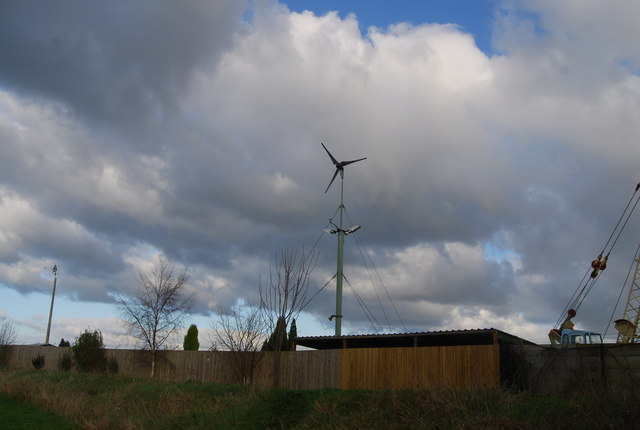

4. Verify tower space, construction access and maintenance access
The turbine foundation is only part of the required space. A guyed tower needs room for supporting wires and anchors; a tilt-down arrangement needs space for raising and lowering. These requirements depend on the proposed tower design. DOE’s community-wind guidance explicitly includes guy-wire space and maintenance clearance in preliminary siting. (energy.gov)
Ask the installer to mark the following on the site plan:
- Foundation and any anchor locations.
- Tower-raising or lowering area, where applicable.
- Delivery and lifting-equipment access.
- Electrical cable route.
- Areas that must remain accessible for servicing.
Do not accept “it fits in the field” as the complete answer. Ask what access is required during construction and later repairs, and whether gates, utilities or other obstacles affect that access.
Soil conditions, construction access, electrical routing, property boundaries and safety are among the land-use constraints identified in the national laboratory’s Small Wind Site Assessment Guidelines. These can prevent an otherwise windy location from being practical. (docs.nlr.gov)
Request a tower-specific foundation assessment and an explanation of any site work excluded from the quote. This is a planning check, not an invitation to design foundations, erect towers or perform electrical work yourself.
5. Confirm permits, setbacks, sound requirements and utility approval
Contact the local planning or zoning office before paying for equipment. Ask which adopted rules apply to the parcel and proposed system. DOE explains that permitting requirements vary by location and may involve zoning approval, building permits, electrical permits, setbacks and sound limits. (energy.gov)
Use this question list:
- Is small wind allowed in this zoning district?
- Is approval routine, conditional or subject to a hearing?
- How is maximum height measured?
- Which setbacks apply, and from what reference points?
- What sound documentation is required?
- Are aviation or environmental reviews relevant?
- Which drawings, engineering documents and fees are needed?
Request the applicable requirements in writing. No nationwide setback or height figure should replace the rules adopted for your parcel.
For sound, ask for evidence for the proposed turbine and an assessment at the locations relevant to local requirements. Turbine sound can include mechanical hum and blade-generated whooshing; its perception depends on airflow, terrain and surrounding sound. A generic claim that a turbine is “quiet” does not answer those site-specific questions. (energy.gov)
For a grid-connected project, contact the utility separately about interconnection, required equipment, fees and export compensation. For an off-grid project, ask how wind variability will be managed through storage, other generation or load management. (energy.gov)
6. Work through an exposed site versus a sheltered property
The following is an illustrative screening exercise, not a report on actual properties or a production prediction. Its reasoning follows DOE guidance on exposure, obstructions and property-specific assessment. (energy.gov)
| Check | Exposed rural field | Sheltered property |
|---|---|---|
| Airflow | An open approach from important wind directions is promising | Trees and buildings make local airflow a concern |
| Tower options | Ask whether a suitable tower fits permitted heights and setbacks | Ask whether any permitted tower can clear the disturbed airflow |
| Installation | Verify delivery, lifting and servicing access | Verify whether restricted access adds another constraint |
| Evidence needed | Hub-height resource assessment and net production estimate | Location comparison, turbulence assessment and height feasibility |
| Preliminary action | Investigate further; do not assume approval | Resolve exposure and tower constraints before selecting a turbine |
Apply the checklist in order. For the exposed field, request an assessment of the candidate location and tower options. For the sheltered property, first ask whether relocating the tower or using an allowable taller tower could address the airflow problem.
If there is no practical way to reach usable airflow within the property’s constraints, pause the wind proposal. That is a reasoned screening decision—not proof that all sheltered properties are unsuitable.
The important lesson is that both layouts could receive similar regional map estimates while requiring different decisions on the ground. DOE cautions that modeled maps may not represent the true resource at an individual location. (energy.gov)
7. Request an assessment report before comparing installation quotes
Ask the assessor whether on-site monitoring would materially improve confidence in the decision. DOE describes measurement near the intended hub height over at least a year as a preferred approach, while acknowledging its additional time, effort and cost. Short observations should not be represented as a complete annual resource assessment. (energy.gov)
Your report should explain the wind evidence, proposed location and tower height, treatment of obstacles, and uncertainty. Request an expected net annual energy range, not just a turbine rating or an unexplained single number.
Production estimates should use the turbine’s power curve with the estimated wind-speed distribution and appropriate site adjustments. Losses and downtime also matter. Some losses may already be included in a certified power curve, so ask the assessor to avoid counting them twice. (docs.nlr.gov)
Before requesting final quotes, ask:
- What evidence supports this location and hub height?
- What remains uncertain, and would measurement change the recommendation?
- How were turbulence and obstacles handled?
- What is the net annual kWh range?
- Which losses are already included in the performance data?
- What permissions remain unresolved?
- Who will service the turbine, and what access must remain available?
DOE recommends tested, certified equipment and consideration of performance, economics, legal constraints and backup options. Certification helps evaluate equipment; it does not establish that your property is a suitable site. (energy.gov)
Your next step: assemble the property map, electricity records, wind-screening evidence and preliminary authority responses. Use them to commission a site assessment. Choose the turbine only after the site—and its limitations—are understood.