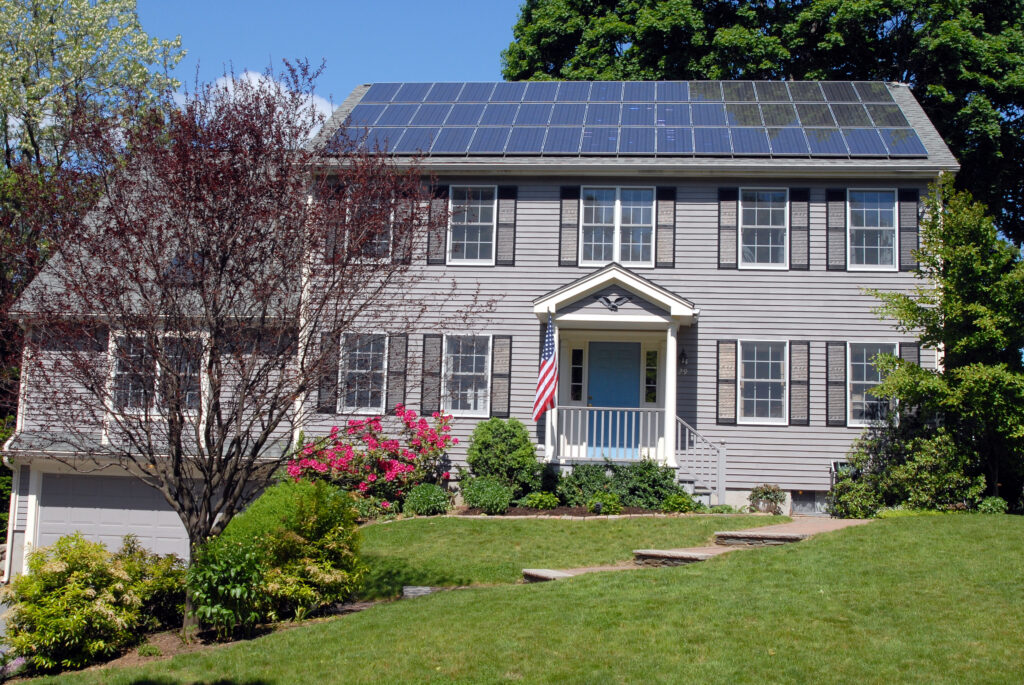
Quick answer: Ordinary grid-connected solar usually stops supplying electricity when the utility grid fails—even in bright sunshine. This safety behavior prevents an unintended electrical “island.” Backup requires equipment specifically designed to operate independently of the grid, with safe isolation and controls. A battery alone does not guarantee backup; some specially configured solar systems can provide limited daytime power without a household storage battery. (energy.gov)
This guide focuses on U.S. homes and small properties. The equipment principles apply broadly, but your utility’s interconnection requirements and local permitting rules must be checked for your location.
1. Why sunlight does not guarantee electricity during an outage
Solar panels generate direct-current electricity. An inverter converts that output into the alternating-current electricity used by household appliances. But conversion is only part of the inverter’s job: operating safely with—or independently of—the utility grid also matters. (energy.gov)
A conventional grid-connected system normally operates alongside the utility supply. When that supply disappears, the solar system generally stops delivering power rather than attempting to run the house by itself. The Department of Energy explains that residential panels alone do not make a home resilient to outages. (energy.gov)
Consequently, an outage on a sunny afternoon does not necessarily indicate faulty panels or a defective installation. It may be the expected behavior of the system you purchased. Advanced inverters can support independent operation, but only when the system is designed for it. (energy.gov)
Your first practical check: Find the inverter model and the installation’s equipment schedule. Ask the installer to identify the documented outage operating mode—not merely whether the inverter is described as “smart,” “hybrid” or “battery-ready.”

2. Anti-islanding protects the grid; intentional islanding enables backup
An electrical island is a section of the network that remains powered by local generation after losing its connection to the wider grid. An unintended island can threaten workers who believe lines are de-energized and can create unstable electrical conditions that damage connected equipment. (energy.gov)
Anti-islanding is the protective behavior that prevents this unintended operation. It is not a feature to bypass to obtain backup electricity.
Intentional islanding is different. A properly designed system disconnects its local electrical network from the utility and operates that isolated network under controlled conditions. DOE describes systems capable of this separation as microgrids, which can be as small as a single customer’s installation. (energy.gov)
The distinction is simple:
- Unsafe situation: Local generation continues energizing a network that was not intentionally isolated.
- Backup situation: Approved equipment isolates the supported loads and controls their electricity supply independently.
DOE’s microgrid example explicitly shows the service disconnect opening to prevent electricity from feeding back into the utility grid before local generation supports selected buildings. (energy.gov)
Ask your installer to show the isolation point on the electrical diagram. Do not treat switching off a breaker as proof that an ordinary solar inverter can operate independently.

3. Compare three clearly defined solar configurations
These configurations describe installed systems, not simply lists of products. Their outage behavior depends on how the equipment is connected and commissioned.
| Configuration | What happens during an outage? | Main limitation |
|---|---|---|
| Standard grid-connected solar: panels and conventional grid-connected inverter; no independent-operation capability | Solar stops supplying the premises when the grid fails. | No solar backup, even when sunlight is available. |
| Solar with a dedicated daytime backup outlet: compatible inverter, required accessories and a configured independent outlet; no household storage battery | The designated outlet can supply selected devices when enough solar energy is available. | Limited output and no stored energy for nighttime operation. |
| Island-capable solar-plus-battery: compatible generation and storage equipment, grid-isolation equipment, controls and specified backup circuits | The isolated system can supply supported loads from solar and stored energy. | Available charge, solar conditions and equipment power limits constrain operation. |
The first and third configurations follow DOE’s descriptions of conventional solar and backup-capable solar-plus-storage. The daytime-outlet configuration is a documented manufacturer-specific exception, not a capability of every solar inverter. (energy.gov)
A further distinction matters: a property can have solar and a battery without having solar-supported backup. Some arrangements shut down the solar inverter during an outage while the battery supplies appliances. Other arrangements allow solar to operate and recharge the battery while isolated from the grid. (energy.gov.au)
When comparing proposals, ask each bidder to state which configuration is included and which circuits receive electricity during an outage.
4. What battery-supported backup actually requires
Backup is a system function. DOE says solar-plus-storage systems need advanced inverters capable of operating without grid support, and it qualifies that capability with an important condition: they must be designed to do so. (energy.gov)
For a proposed installation, request a diagram identifying:
- The inverter or equipment that establishes the local electrical supply.
- The device that isolates the backup network from the utility.
- The circuits or outlets included in backup.
- Whether solar remains operational and recharges storage during an outage.
- The controls and settings used for outage operation.
The isolation arrangement may involve a transfer switch or other purpose-designed equipment. The acceptable arrangement is project- and utility-specific. In its backup installation guide, California utility PG&E advises customers to confirm both that their equipment supports islanding and that their interconnection agreement allows it. (pge.com)
That is a useful planning principle elsewhere, not a nationwide approval rule. PG&E also currently treats storage devices as generators for California Rule 21 interconnection purposes—another reason not to assume a battery addition is merely an appliance purchase. (pge.com)
Also separate whole-home connection from unlimited operation. Manufacturer guidance distinguishes partial backup, which supports selected essential loads, from whole-home backup; the appropriate design depends on household demand and installed storage equipment. (tesla.com)
For a rural property, explicitly discuss well pumps and other essential equipment rather than assuming that “backup outlets” covers them.
5. Daytime-only backup can help, but it is not overnight storage
Some equipment provides outage electricity without a household storage battery. However, that does not mean ordinary grid-connected solar can do the same.
One documented U.S. example is SMA’s Sunny Boy Smart Energy with its optional Backup Secure function. SMA’s published product information describes output of up to 1,920 watts at 120 volts. Its operating manual says selected loads connect through a dedicated socket, operation starts manually through a connected switch, and the feature requires SMA Backup Start. These details are specific to that documented configuration. (sma-america.com)
For a system without household energy storage, consider three limits:
- No overnight energy: Solar-only backup supplies electricity when sunlight is available, not after dark. (energy.gov.au)
- Variable production: Clouds, shading, season and other conditions affect solar output. The feature’s maximum rating is not a promise of continuous available power. (energy.gov)
- Restricted connection and output: A dedicated 120-volt outlet is not equivalent to backing up every circuit in the property. (sma-america.com)
Ask what happens when connected demand exceeds available solar production, how operation resumes, and whether someone must be present to activate the feature. Get the answers for the exact model and installed accessories.
This option may fit a modest daytime objective. It should not be described in a proposal as equivalent to night-capable battery backup.
6. Estimate backup duration from energy and demand
Two units help separate the questions:
- Kilowatts (kW) describe power at a particular moment.
- Kilowatt-hours (kWh) describe energy supplied or consumed over time.
A one-kilowatt load operating for one hour uses one kilowatt-hour. (eia.gov)
For a simple no-solar calculation:
Estimated runtime in hours = energy available to the loads in kWh ÷ average supported demand in kW
Illustrative example—not a measured installation or product claim:
Suppose a proposed backup system has 6 kWh available to its supported loads, after accounting for the applicable reserve and losses. Suppose those loads average 0.5 kW.
6 kWh ÷ 0.5 kW = 12 hours
If average demand rises to 1 kW, the same assumed energy lasts 6 hours. This is arithmetic based on stated assumptions, not a forecast for your home.
The power check is separate: a system can have sufficient stored energy yet still be overloaded by simultaneous appliance demand. Tesla’s outage guidance, for example, warns that excessive loads can stop its backup supply and recommends reducing energy-intensive appliance use. (tesla.com)
For a realistic proposal, request calculations using:
- The charge expected when the outage begins.
- Energy actually available above the operating minimum.
- Supported-load consumption and operating schedules.
- Continuous and starting-power requirements.
- Storage losses and system consumption.
- Local, seasonal solar production during the assumed outage.
Storage is not perfectly efficient, and sunlight varies. Do not add an optimistic day’s solar production to the runtime calculation without identifying those assumptions. (energy.gov)
7. Avoid common mistakes and get outage behavior in writing
Mistake: “It has a battery, so it has backup.”
Check whether independent operation is included and whether solar can recharge the battery during an outage. Neither follows automatically from owning storage. (energy.gov.au)
Mistake: “All my appliances can run together.”
Request a supported-load schedule and power assessment. Manufacturer guidance makes backup capability dependent on the installed equipment and household demand. (tesla.com)
Mistake: “A full battery means solar will keep producing.”
An isolated system must manage surplus generation. For example, Tesla documents reducing or stopping solar output when production exceeds what the home can use and the battery can store. That can be normal control behavior. (tesla.com)
Mistake: Treating electrical isolation as a DIY workaround.
Use a qualified installer for the backup design and utility coordination. Do not bypass protective controls or improvise connections to household wiring. PG&E’s guide directs customers to qualified electricians or contractors for applicable installation requirements. (pge.com)
Before accepting a proposal, ask:
- What exactly receives power if the grid fails at noon? At midnight?
- Is transfer automatic or manual, and what interruption should I expect?
- Which circuits are excluded?
- Can the proposed system support each essential appliance’s running and starting demand?
- Will solar recharge the battery while the grid remains down?
- What happens at low charge, overload or insufficient sunlight?
- Can the system restart without grid power, and under what conditions?
- Which isolation equipment, accessories and settings are included?
- Who handles permitting and utility interconnection?
- Can you demonstrate the specified outage mode safely during commissioning?
Request separate prices for storage, inverter changes, isolation equipment, circuit work, controls, permits and commissioning. That makes the additional cost of backup visible instead of leaving it hidden inside a solar package.
Your purchasing decision should rest on a written outage operating description, a supported-load list and stated runtime assumptions—not the presence of panels or a battery.